
Most hydration advice is either too vague to use ("drink plenty of water") or written for marathon runners. Here is the simple version for people who train hard, in ounces, with no math beyond a bathroom scale.
Three windows matter: before, during, and after. Get those right and you feel it by the end of the week.
The short version
| When | How much | What |
|---|---|---|
| 2 to 4 hours before | 16 to 20 oz | Water with electrolytes |
| 20 minutes before | 8 oz | Plain water |
| Every 15 to 20 minutes during | 6 to 8 oz | Water. Add electrolytes past an hour or in heat |
| Within 2 hours after | 24 oz per pound lost | Water with electrolytes |
That last line is the one most people have never heard, and it is the one that changes how tomorrow feels. More on it below.
Find your number with a bathroom scale
Everything above is an average. Your actual sweat loss might be half that or triple it. You can find your real number in one session.
Weigh yourself before training. Weigh yourself again right after, toweled off, same clothes. Every pound you lost is 16 oz of sweat. Add whatever you drank during the session.
Say you drop 2 pounds and drank 16 oz along the way. That is 32 oz from the scale plus the 16 oz you drank, so 48 oz of sweat in that session. Just under half a gallon, in an hour.
Once you know that number, the rest of this guide stops being generic.

Before training
The goal is to show up topped off. Once you are behind, you spend the whole session chasing it, because your gut can only absorb so fast.
- 2 to 4 hours out: 16 to 20 oz of water with an electrolyte stick. The lead time matters. It gives your body time to take on what it needs and pass what it does not, so you start work hydrated instead of sloshing.
- 20 minutes out: another 8 oz of plain water. A top-up, not a second dose.
- The check: your urine should be pale, like light straw. Dark means you are starting behind. Completely clear usually means you overdid plain water.

If you train first thing in the morning
You wake up dehydrated. Seven or eight hours of breathing and sweating with nothing to drink puts most people down a pound or two before they have done anything. There is no time for a four-hour head start, so drink 12 to 16 oz with electrolytes as soon as you are up, then get moving 30 to 45 minutes later.
During training
You are not trying to replace everything in real time. That is uncomfortable and mostly impossible. You are trying to keep from digging a hole.
- Under an hour: water is fine if you showed up hydrated. Six to eight oz every 15 to 20 minutes.
- Over an hour, or anything in the heat: add an electrolyte stick. Past that point plain water starts working against you, thinning out the sodium you are actively sweating out.
- Sip, do not chug. A big slug of water mostly sits in your stomach. Smaller amounts more often actually get absorbed.
- Do not drink so much that you gain weight. If the scale is up after training, you drank more than you sweated.
The problem with most hydration advice for CrossFit
Nearly every protocol you will find was written for steady-state endurance work, where you can sip every fifteen minutes for two hours. That is not how a class runs. You get 45 to 75 minutes, and most of the sweat comes out of a 12-minute metcon you are not stopping in the middle of.
So for functional fitness, the dose before and the dose right after carry the weight that mid-workout sipping carries for a runner. Plan around that instead of pretending you will drink during an AMRAP. If you want the product side of this, we cover it in our guide to the best electrolyte for CrossFit.

After training
This is the window people get wrong, and it has the biggest effect on how you feel the next day.
For every pound you lost, drink about 24 oz. Not 16. You keep sweating and making urine after you stop, so replacing exactly what the scale says leaves you short. Two pounds down means about 48 oz over the next couple of hours, not all at once, ideally with a meal.
Sodium is what makes it stick. Without it, a big volume of plain water just thins your blood, your body reads that as too much fluid, and you pass most of it. That is why chugging water after a hard session often means a bathroom trip twenty minutes later and still feeling thirsty.
If your next session is more than 12 hours away, normal meals and drinking when you are thirsty will get you there. It is the tight turnarounds that need a plan.

What you are replacing
Sweat is not just salty water. You lose five minerals every session, and most products only seriously address the first one. Here is what one Engineered Nutrition stick puts back.
| Mineral | Per stick | What it does |
|---|---|---|
| Chloride | 690 mg | Fluid regulation, digestive support |
| Sodium | 600 mg | Fluid balance, nerve and muscle function |
| Potassium | 188 mg | Heartbeat regulation, muscle function |
| Calcium | 52 mg | Bone strength, muscle function, nerve signaling |
| Magnesium | 34 mg | Fluid balance, nerve and muscle function, energy |
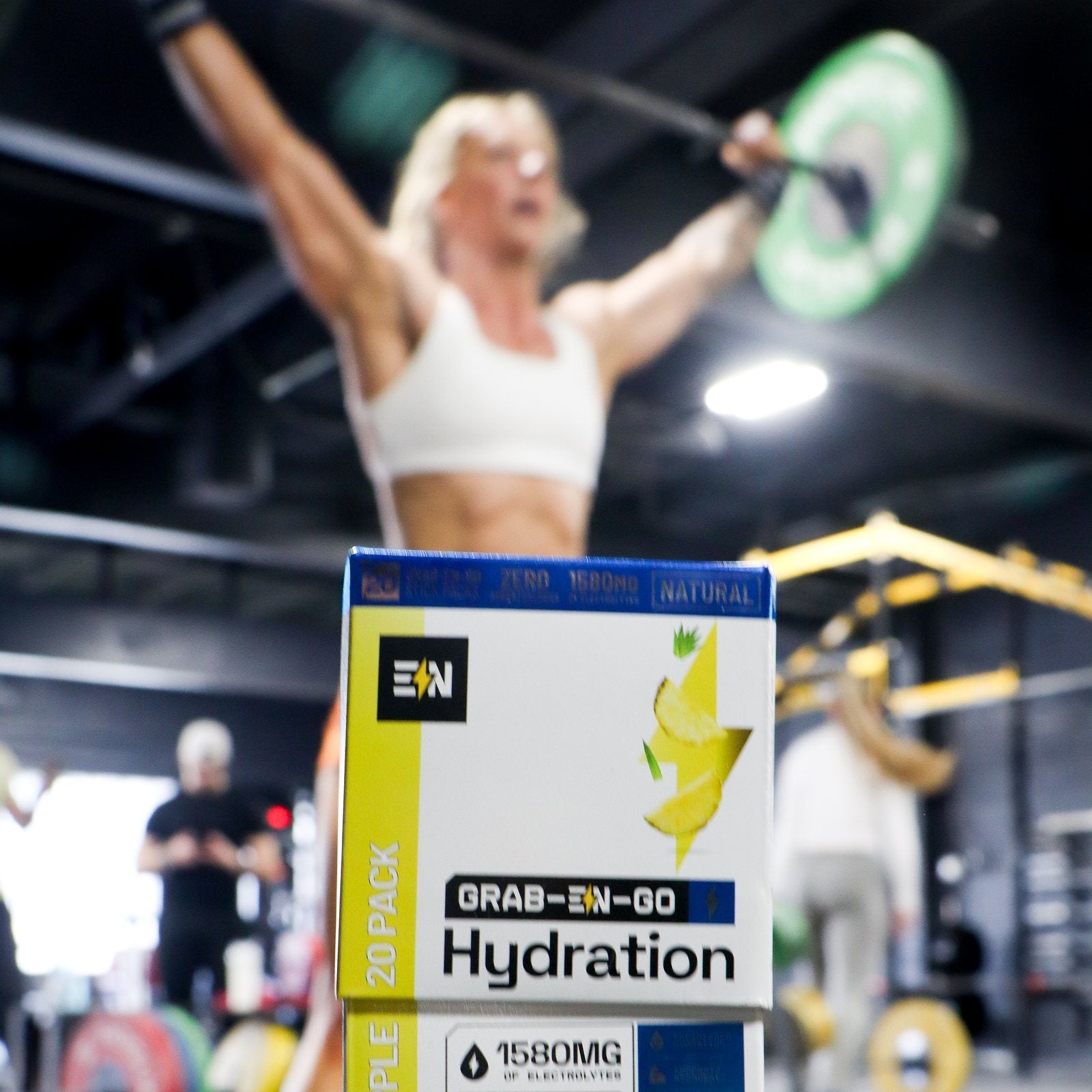
Plus zinc (10 mg), vitamin B6 (3.4 mg) and vitamin B12 (5 mcg) for immune support, nerve function and energy. That is 1,580 mg of electrolytes total, zero sugar, zero calories.
The reason the full set matters: sodium is what helps you hold onto fluid, but potassium, calcium and magnesium are the ones tied to muscle and nerve signaling. A sodium-only product can leave you perfectly on schedule and still short on the rest. You can see the full label and third-party testing on the ingredients page, or compare it against other brands in our zero-sugar electrolyte comparison.

Adjusting for your situation
Hot weather
Heat and humidity both push your sweat rate up, and humidity is the worse of the two because sweat cannot evaporate to cool you. Anything above about 80°F, or a humid garage gym in July, and you should re-run the scale test. Most people find their summer number is a lot higher than their winter number. The full hot-weather picture, including why plain water stops being enough, is in why you cramp in hot weather (even if you drink water).
Two-a-days
The gap between sessions is the whole game. If you train again within four hours, get 24 oz back for every pound you lost in the first session before the second one starts. Showing up to an evening session still down from the morning is the fastest way to make normal programming feel brutal.
Are you actually a salty sweater?
People use this label loosely. The real version is two things at once: visible salt marks on your hat and skin, and a very high sweat rate, north of about two-thirds of a gallon an hour. Both, not one. If that is you, add a second stick on hard days rather than just drinking more water, which only thins things out further.
Competition day
Do not try anything new. Run the plan you already tested in training. If you compete in a tested division, make sure everything in your bag is third-party certified. Engineered Nutrition is Informed Sport certified and screened for more than 250 banned substances, which matters because the athlete carries the responsibility, not the brand.
Five mistakes worth fixing
- Waiting until you are thirsty. Thirst shows up around the point where you are already down about 2% of your body weight, roughly 3.5 pounds on a 175-pound athlete.
- Chugging right before you train. Twenty ounces ten minutes out gives you a sloshing stomach and a bathroom trip. The window is hours, not minutes.
- Plain water for long or hot sessions. Past an hour you are thinning out exactly what you are losing.
- Only replacing sodium. It solves fluid retention and ignores the other four minerals.
- Skipping the window after. Every session you under-replace, you start the next one further behind.
Frequently asked questions
Should I drink electrolytes before or after a workout?
Both, if you train hard. If you can only pick one, take the one after. That is where sodium does the most work, because it is what lets your body hold the fluid instead of passing it straight through.
How much water should I drink before a workout?
About 16 to 20 oz two to four hours ahead, then another 8 oz twenty minutes before you start. Drink more if you sweat heavily or it is hot. Pale straw urine before you begin is the practical check.
How much water should I drink after a workout?
About 24 oz for every pound you lost, spread over the next two hours. If you did not weigh in, 16 to 24 oz alongside your next meal is a reasonable default for a normal session.
Do I need electrolytes for a 45-minute workout?
Usually not during it, if you showed up hydrated. Water is fine. The doses before and after still matter, especially for high-intensity work where you can sweat a lot in a short window.
Can I just put salt in my water?
It covers sodium and chloride. It misses potassium, calcium and magnesium, which you also lose. Most people also stop drinking it, because it tastes like the ocean, which defeats the point.
Can you drink too much water when training?
Yes. Large amounts of plain water beyond what you are sweating thins out your blood sodium. It is rare in a one-hour gym session and much more of a concern in long endurance events, but the principle holds either way: drink to your sweat rate, not to a target.
Is there a downside to taking electrolytes every day?
For most healthy people replacing real sweat losses, no. More is not automatically better, though, and anyone managing blood pressure, kidney issues, or another condition affecting fluid balance should check with a doctor first.
The whole thing in one line
Weigh yourself once. Drink 16 to 20 oz a few hours before, sip through the session, and put back 24 oz for every pound you lost.
Sources. American College of Sports Medicine, Exercise and Fluid Replacement position stand, 2007. · National Athletic Trainers' Association, Fluid Replacement for the Physically Active position statement, 2017. · Baker, Sweating Rate and Sweat Sodium Concentration in Athletes, Sports Medicine, 2017. Ounce figures are converted from the metric values published in those documents.
Last updated July 2026. Nutrient amounts reflect the printed supplement facts panel. This is educational content, not medical advice. These statements have not been evaluated by the Food and Drug Administration. This product is not intended to diagnose, treat, cure, or prevent any disease.
Want the exact protocol for your sport? The Hydration Playbook gives the measured fluid and sodium cost, and a before/during/after protocol, for 46 activities — CrossFit, marathon, football, hot yoga, shift work and the rest.


